

Choosing the right security camera for your Singapore construction site is an important choice. Technology needs to be strong and fit for the job in a harsh environment with a changing landscape [1]. There are three main types of cameras: Fixed Cameras, PTZ (Pan-Tilt-Zoom) Cameras, and 360° Cameras. Each one has a different purpose. To set up a good and cost-effective video surveillance system for construction sites, you need to know their strengths and weaknesses.
1. Fixed Cameras: The Reliable Workhorse
- Best For: Keeping an eye on certain high-value areas all the time.
- Day/Night Use: Great for 24/7 surveillance of fixed choke points like site entrances, material storage yards, equipment compounds, and access to site offices.
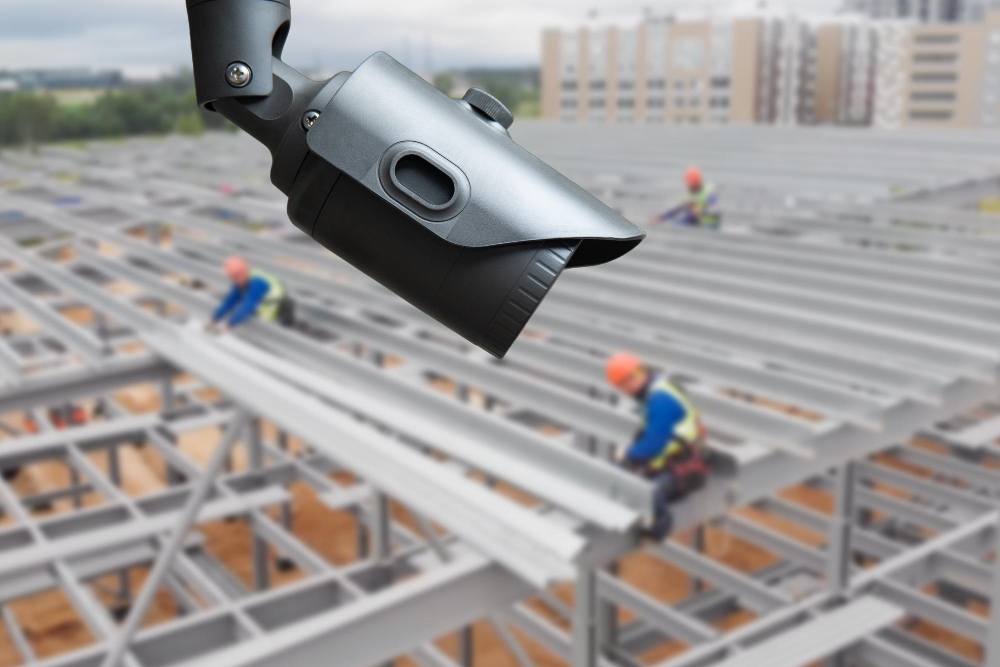
- Site Task Match: Great for perimeter security, keeping an eye on restricted zones, and watching high-activity work areas where the field of view is always the same [2].
- Cost & Bandwidth: Usually the cheapest option per unit. They use a steady amount of bandwidth, which makes them good for large-scale deployment.
- Mounting & Weather: They are easy to put up on walls, poles, and buildings. Must have a high Ingress Protection (IP) rating (like IP66 or IP67) to be able to handle the rain, dust, and humidity in Singapore [3].
- For Construction Sites: A network of well-placed fixed cameras is the most important part of any site CCTV system [1].
2. PTZ Cameras: The Commanding Overseer
- Best For: Actively watching large, open areas and giving forensic detail.
- Day/Night Use: Combines wide-area observation with the ability to zoom in on incidents. Operators can read a license plate or see someone’s face from hundreds of feet away by panning 360°, tilting, and using a powerful optical zoom.
- Site Task Match: Great for sweeping big open excavations, keeping an eye on big laydown areas, and giving live surveillance for tower crane CCTV systems in Singapore. They are very useful for security staff who need to keep an eye on suspicious activity [4].
- Cost and Bandwidth: It costs more up front and needs more complicated mounting, which often means using a junction box. When the PTZ moves and zooms, it uses a lot of bandwidth, so the network needs to be strong [5].
- Mounting and Weather: Needs a mount that is stable and won’t shake, especially when it’s windy. Must have high ratings for IP and resistance to vandalism [3].
3. 360° Multi-Sensor Cameras: The Hub for Situational Awareness
- Best For: Giving a full view of a complicated area with no blind spots.
- Use During the Day and Night: Uses several lenses to get a full 360° field of view in one stream. This “bird’s-eye view” is great for command posts. One of its best features is digital PTZ, which lets operators zoom in on any part of the stitched panorama without moving the camera [6].
- Site Task Match: This is the best option for site time-lapse projects because it can capture the whole progress of a build from one central point, like the roof of a site office. Also great for keeping an eye on busy places where a lot of things are going on, like the base of a tower crane or a busy logistics hub [4], [6].
- Cost and Bandwidth: A lot of money up front, but it can often replace three or four fixed cameras in one place. Provides full coverage with just one cable run and mount, making installation easier [5].
- Mounting and Weather: Mounting at one point makes installation easier. Like all outdoor construction tools, it needs to have a high weatherproof rating [3].
Compare the Two Cameras: Which One Will Fix Your Problem?
| Consideration | Fixed Camera | PTZ Camera | 360° Camera |
| Primary Role | Constant watch on a specific spot. | Active patrol & forensic investigation of a large zone. | Complete situational awareness from a single point. |
| Ideal Site Location | Gates, fences, warehouse doors, fixed machinery. | Open areas, material yards, perimeter of large sites. | Site offices, crane bases, central compounds. |
| Cost (Relative) | Low | High | High (but replaces multiple cameras) |
| Operator Skill | Set-and-forget; minimal intervention. | Requires active control or preset patrol patterns. | Easy to navigate digitally post-installation. |
| Best For Long-Tail Query | “Best fixed camera for construction site gate” | “Remote control CCTV for large construction site” | “Single camera to view entire construction site” |
Choosing the Right Strategy for Your Site
The best way to do construction site video surveillance is to use a mix of different methods [2], [7]:
- Layer Fixed Cameras at all important, fixed points to ensure reliable coverage.
- Deploy PTZ Cameras in smart ways to cover large, open areas and give investigators more power.
- Utilize 360° Cameras in central locations for master views, time-lapse, and operational oversight, especially for “tower crane operations.”
Important Factors to Consider:
- Budget vs. Coverage: Fixed cameras give you the most coverage points for your money. PTZ and 360° cameras give you more features for each unit [5].
- Network Infrastructure: Can your site’s network handle the bandwidth of several high-definition PTZ or 360° streams at once [5]?
- Monitoring Style: Do you have active security staff (who benefit from PTZ), or is the system mostly for recording and reviewing (where fixed and 360° do well) [4], [6]?
Next Step: Talk to an expert in video surveillance systems for construction sites, such as Shunamite, about doing a site survey [7]. They can plan where to put cameras, take into account Singapore’s unique environmental issues, and suggest certified models that strike a balance between performance, durability, and total cost of ownership, making your surveillance plan a reality.
References
[1] Ministry of Manpower (MOM), Singapore. (2023). Workplace Safety and Health (Construction) Regulations
[2] Building and Construction Authority (BCA), Singapore. (2022). Circular on Enhancing Safety at Construction Sites
[3] International Electrotechnical Commission (IEC). (2021). IEC 60529: Degrees of Protection Provided by Enclosures (IP Code)
[4] Shunamite Pte Ltd. (2023). Technical Specifications: Tower Crane CCTV Systems. Note: This is likely an internal company document.
[5] National Institute of Standards and Technology (NIST). (2020). Guidelines for Managing and Securing Networked Devices
[6] Shunamite Pte Ltd. (2023). Application Note: 360° Camera Deployment for Construction Sites.
[7] Shunamite Pte Ltd. (2023). Consultation Framework: Site Survey and Security Planning.